

Survival Guide: Meta Ads Andromeda Update
Creative is the new targeting. If your ads aren’t working like they used to, it might not be your fault.
Wait… Why Did My Ads Stop Working?
Are your tried-and-true audiences suddenly falling flat? Is your CPA climbing even though your targeting looks perfect? You’re not alone.
There’s a reason this is happening, and it has everything to do with how Meta’s algorithm has changed.
Meta has been rolling out the Andromeda system since 2024, and now we’re really starting to see the impact on performance. The Meta Ads Andromeda Update marks a major shift away from audience finding and toward creative matching.
For years, the game was about finding the right people. Interest stacking, layered lookalikes, and hyper-specific targeting ruled the day. Now, the winning strategies look very different.
Meta no longer asks “Who should see this ad?” but, “Which ad should this person see right now?”
That’s a big change.
It means you can’t hack your way to performance with settings anymore. The only way forward is better creative. Not just more creative, but diverse creative that helps the algorithm unlock different pockets of opportunity in the auction.
So… What Changed Inside Meta?
Prior to the Andromeda update, Meta optimization was a king-of-the-hill system. The platform found one winning ad, pushed budget into it, and rode it until performance dropped off.
Andromeda works more like a portfolio.
Instead of betting everything on one ad, Meta now wants a mix of creatives that serve different roles for different people at different moments. One person might respond to a founder story. Another might need a testimonial. Someone else might convert after a quick product demo.
This shift isn’t just strategic, but technical.
Meta has invested heavily in new infrastructure, including custom MTIA chips and NVIDIA Grace Hopper superchips. Yeah, it’s a mouthful. The simple version: Meta understands the order of ads someone needs to see before they convert.
The system isn’t guessing anymore. It’s predicting.
Instead of trying to find one perfect ad, the algorithm is choosing the right ad from your library at the right time.
Old-school targeting strategies are falling apart because they were built for an earlier version of the platform.
Why Your Ads Feel Stuck
For a lot of advertisers, Andromeda hasn’t caused a sudden crash. It’s caused something worse. Campaigns stall, budgets stop spending, and results flatten out without a clear reason why.
Nothing looks broken. Targeting is set up correctly, and metrics look fine. But growth is harder to unlock than it used to be.
That’s because the old levers don’t work the same way anymore. Adding another interest or duplicating a winning ad doesn’t automatically move the needle. The algorithm now has more control over delivery and is making decisions based on predicted performance, not just on what worked before.
This is why so many accounts feel stuck right now. It’s not that the ads are bad, but that the system needs more creative inputs to learn from.
Once advertisers stop chasing targeting tweaks and start feeding the algorithm better creative, things start to move again.
“More Creative” Isn’t the Answer
Here’s where many advertisers get tripped up.
They hear “make more creative” and assume that means swapping a hook or tweaking the text on the same ad. (Guilty.) But that’s not enough anymore.
Creative diversity means changing the format, the angle, and the visual language so your ads don’t compete with each other in the auction.
If everything looks and feels the same, Meta treats it the same. That creates overlap and limits delivery.
At Social Fire Media, we intentionally launch varied creatives so the algorithm always has something new to work with.
The Meta Ads Andromeda Update rewards advertisers who give the system options: more creators, hooks, formats, and angles.
Creative is the new targeting, but only if it’s actually diverse.
Here’s What Actually Works
Creative diversity sounds abstract until you see it in action.
When testing image-based remarketing ads, we’ve changed how we launch creative. Instead of making small tweaks, we prioritize high variance. That means launching ads that look and feel completely different from each other, not just slightly adjusted versions of the same idea.
Small changes often don’t create meaningful performance shifts. But when a concept really resonates, it shows up fast. Spend increases. Engagement improves. That’s the signal we pay attention to.
Once something is working, that doesn’t mean you stop testing. It means you can take bigger swings around that winning idea. You might keep the same core angle but change the visual completely. Swap a static image for someone saying the line on camera. Use a different person, setting, or format. The key is that the ads look visually different while still leaning into the message that’s already proven to resonate.
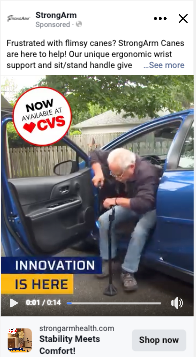

A good example of this came from our work with StrongArm. Early tests showed that ads featuring a clear, immediate demo of someone pulling themselves up from a chair consistently outperformed other visuals. That single moment communicated the product’s value instantly and stopped people mid-scroll.
Once we saw that pattern, we leaned into it. Most of the top-performing images and videos that followed focused on that same action. Not because we were repeating ourselves, but because we were intentionally scaling a concept that clearly worked.
This approach gives the algorithm more options to test and clearer signals to learn from. High variance first. Replication once something clicks.
When More Than One Creative Wins
Not every account has a single “hero” ad. And that’s not a problem.
With Friends Life Care, we’re currently running multiple video styles at the same time, all performing well, even though the content looks and feels very different. One version is more explainer-focused, using animations and statistics to clearly communicate value. Another leans more lifestyle-driven and emotional. We’re also running a UGC-style video that feels more personal and conversational.
There isn’t one clear winner here, and that’s the point.

Each video is connecting with a different audience. Some people respond better to facts and structure. Others connect more with real people or emotional storytelling. Even when one ad doesn’t perform “as well” as another on the surface, it can still be doing its job by reaching the right segment and driving meaningful results.
This is one of the biggest mindset shifts under Andromeda. Performance isn’t about finding a single best ad anymore. It’s about having multiple winners working together. Different messages for different people, all moving toward the same goal.
When we test creative, we’re really looking for patterns. Once we see what actually resonates and helps sell the product, we lean into it instead of constantly changing direction. That’s how we’re able to replicate what works and keep launching strong ads over and over again. The goal isn’t small tweaks. It’s finding visuals and messaging that click with the right people and scaling from there.
BRENDAN MCMAHON, SFM CO-FOUNDER
 BRENDAN MCMAHON
Creator Content Matters
Creator content matters more than ever. Not just because the algorithm likes it, but because people do too.
In a world where feeds are increasingly filled with polished ads and AI-generated content, real people stand out. Creator content feels human. It sounds like someone talking to you, not selling to you. That authenticity drives stronger engagement, longer watch times, and more meaningful interaction, all signals the algorithm pays close attention to.
Creator content also brings built-in variation. Differences in tone, delivery, pacing, visuals, and perspective happen naturally when real people are involved. Even when two creators are talking about the same product, the content doesn’t feel the same. That diversity gives Meta more opportunities to match the right message to the right person at the right moment.
From a performance standpoint, creator content makes scaling easier. Brands can rotate through creators, hooks, and formats while staying anchored to what works. Creative stays fresh longer, fatigue shows up later, and the algorithm has a steady stream of new inputs to learn from. It’s not about chasing trends. It’s about giving the system what it needs to keep delivering.
The Metrics That Matter Now
Creative fatigue didn’t go away. It just got harder to spot.
In the past, fatigue was obvious. Click-through rates dropped, and performance fell off a cliff. Today, it’s sneakier. Delivery slows. Spend hits a ceiling. Results flatten out without a clear warning sign.
That’s because Andromeda predicts fatigue before people fully tune out. Instead of waiting for engagement to drop, the system limits delivery when it believes an ad is about to underperform. That’s why surface-level metrics aren’t enough anymore.
Two of the most important signals today are hook rate and hold rate. These metrics tell you how your creative performs before conversion ever enters the picture.
Hook rate shows whether your opening seconds earn attention. If people scroll past immediately, the algorithm learns that the creative isn’t worth delivering at scale.
Hold rate shows whether the message keeps attention long enough to communicate value.
These signals are especially important under Andromeda because delivery decisions are made earlier in the funnel. An ad doesn’t need to fail outright for performance to suffer. If attention drops off too quickly, reach and spend can be limited long before conversion metrics decline.
This is why relying on CTR alone can be misleading. An ad may still generate clicks while quietly losing distribution. Understanding how people engage with creative helps identify issues early and guides smarter iteration.
At Social Fire Media, we go deeper than native platform metrics. We use AI-powered tools like Motion to analyze video performance frame by frame. We tag creative elements like pacing, text overlays, creator type, and visual style, then look for patterns across ads.
This is what creative IQ actually looks like. You’re not just chasing winners. You’re learning why something worked and how to repeat it. That’s exactly what the Meta Ads Andromeda Update rewards.
Okay… So Now What?
If you’re still boosting posts or launching one new ad every week, it’s going to feel harder than it should.
Winning under Andromeda isn’t about finding a single perfect ad. It’s about building a repeatable way to produce, test, and learn from creative at a pace the platform can work with. Volume matters. Variety matters. And consistency matters most.
The brands seeing results today aren’t flawless. They show up. They listen to the data. And they adjust without overthinking every move.
If keeping up with that pace feels overwhelming, that’s normal. Most internal teams aren’t built to manage high-volume creative testing on top of everything else they’re responsible for.
That’s where Social Fire Media comes in. We help brands build creative systems designed for how Meta works today, so performance feels more predictable and less stressful.
If your Meta ads feel stuck or inconsistent, let’s review your creative and identify where you can improve. No pressure. Just a conversation.